
We are living through a period of genuine global unrest. There are active wars on several fronts. There are major powers, in both East and West, whose actions, behaviours and ethics cannot be taken on trust. And that erosion has spread inward — into how people feel about their governments, about the people who hold power, about large global corporations, and most sharply of all about big-tech.
At the same time, technology is advancing at breakneck speed and embedding itself into every corner of life. It is in our homes, our vehicles, our schools, our hospitals and our doctors’ surgeries. It is at sea, in the skies, and orbiting the planet. You could reasonably argue it is now inside our minds — shaping what we see, what we believe, and how society behaves — and that on a growing scale it will soon be inside our bodies.
I want to be clear about where I stand before I go further. I am a deep-tech person at heart. I love what technology makes possible: the convenience, the connection, the way it pushes the boundaries of science and human capability. None of what follows is an argument against technology. It is an argument for being able to trust it.
At a very human level, the question that matters is simple. Do I trust this thing with my safety, my privacy, my money, my home, my children’s school?
I am genuinely a fan of AI. But I keep coming back to one question: is AI being built for the betterment of humankind, or to create a handful of trillionaires? Honestly, the current trend points more towards the latter than I would like. And that matters, because the people building the most powerful tools in human history are the same people asking us to trust those tools without offering us much reason to.
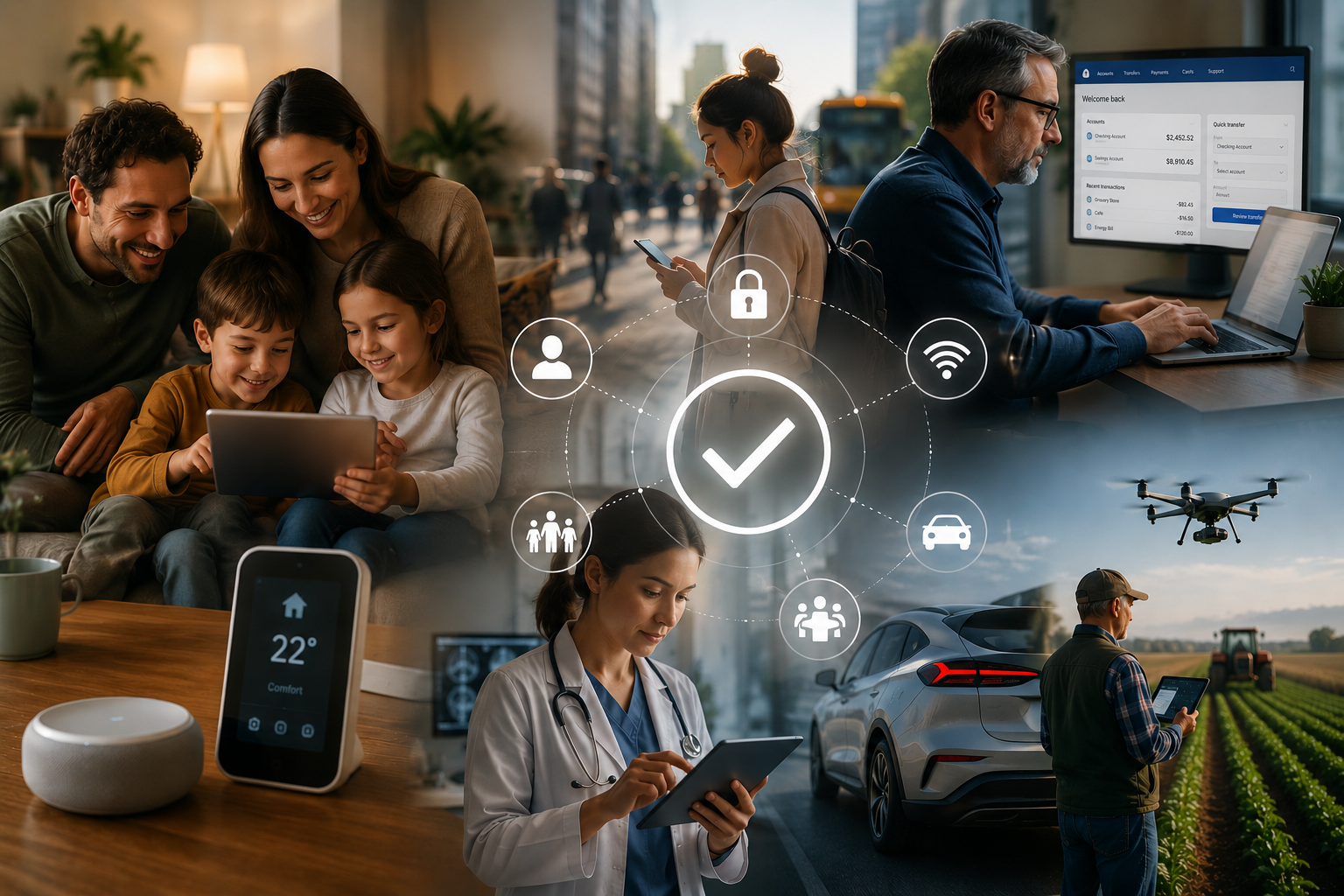
Trust, for an ordinary person, is not abstract. It flows into a set of very practical concerns, and they apply to everything that now counts as “tech” — a device in your home, a car or train or truck or ship or aircraft, a drone overhead doing anything from delivering a parcel to monitoring a crowd to enforcing the law, a medical device on your wrist or an MRI machine in a hospital, the machinery picking fruit and spraying crops in an orchard. All of it is tech now. All of it deserves the same questions.
What does this thing know about me, and why? Is it collecting information for my benefit, or is it harvesting me to sell advertising? That question gets a lot sharper when the device sits in a child’s playroom, or is the car my family travels in every day.
If it is hacked or breached, what harm could it actually cause? This is digital-safety at its most basic. If my smart oven, my smart front-door lock, my garage-door opener, my connected vehicle or my farm machinery is compromised, is my family at risk of real, physical harm? Not inconvenience — harm.
If harm or damage is caused, who is liable? We take mechanical warranties for granted.We expect them on the goods we buy. Yet software warranties and guarantees are rare to the point of being non-existent. So when a device causes harm —physical, financial, environmental, or to your privacy — because it was hacked, or because the AI inside it simply got it wrong that day, is the provider liable for the damage it caused? Right now, mostly, the answer is no.
Does any oft his meet a standard? Do my modern, AI-enabled, connected devices comply with anything that would give me the protections above by default? For the most part, they do not.
Here is the heart of it. When you buy an electrical product, you don’t inspect the wiring.You don’t have to. It complies with quality standards, and if it has a fault that harms or kills someone, there is a chain of liability that leads back to a responsible party. The same is true for the chemical and material content of the things we buy. Someone, somewhere, is accountable.
We have nothing equivalent for the digital safety of products.
Instead we have taken the opposite, and frankly unacceptable, route: we place all of the risk on the consumer. A wall of terms and conditions and a default “Accept” button somehow absolve an entire industry of responsibility when things go wrong.Meanwhile the largest AI companies are embedding themselves into every sector, and organisations and governments are using AI as the justification to cut staff — at the very moment when not one of the major AI providers will guarantee the quality or correctness of the data and the actions their systems produce. The systems themselves tell us as much. “Don’t fully trust the output.” “I might make mistakes.” We have built our future on tools that warn us, in their own words, not to rely on them.
That last point is the one I want to leave you with. The distance between where we are and a world where individuals, families and whole societies can genuinely trust the technology they use every day is, I’d argue, about a mile. And we are not going to close that mile with technology alone.
Closing it requires standards that mean something. It requires liability that lands somewhere real. It requires the people building these systems to design for the moment things go wrong — because in complex systems, things going wrong is not an aberration, it is an expected state. And it requires a shift in mindset from“no incident has occurred” to “people are demonstrably safe.” Those are not the same thing. The absence of harm is not the presence of safety.
That is what digital-safety means to me, and it is why digital trust matters now rather than later. The goal is simple to state and hard to deliver: a world where you can buy the thing, use the thing, and not have to think about whether it is safe —because someone made sure it was, and someone stands behind it if it isn’t.
![[background image] image of contact center space (for a data analytics and business intelligence)](https://cdn.prod.website-files.com/image-generation-assets/c6108207-eb8f-4df4-bf21-2ada31eda025.avif)